A benchmark of ten tasks from eight datasets for studying IMU multi-task performance and cross-task transfer, with InrtlWrist, a reusable pretrained wrist-IMU encoder.
Northwestern University · *Equal contribution
Abstract. Wrist-worn inertial measurement units (IMUs) provide a common sensing modality for tasks ranging from activity and gesture recognition to pose estimation, inertial odometry and clinical motor assessment. Existing wearable benchmarks evaluate performance across multiple tasks, but leave open how supervision for one task affects transfer to others and whether these tasks benefit from a shared representation. We present IMU-Bench, a benchmark of ten tasks from eight datasets for studying IMU multi-task performance and cross-task transfer. We compare six self-supervised methods pretrained on unlabeled recorded and simulated wrist motion, evaluating classification, pose and velocity estimation, and IMU–language retrieval. We find that our masked autoencoder, InrtlWrist, achieves the best or joint-best frozen-probe performance on nine of ten tasks, and fine-tuning improves on training from scratch on nine of ten tasks, including full-body pose, odometry and retrieval. Across transfer and joint-training experiments, supervision that benefits one target can reduce performance on others, with supervised sources transferring within kinematic estimation while, under frozen probing, none approaches the pretrained encoder on language retrieval, and joint-training gains that come at a cost to the paired task. These findings distinguish broad downstream usefulness from complementary task supervision. Code, task cards, the InrtlWrist weights and a leaderboard are publicly available.
Why this is hard. Different downstream tasks reveal distinct aspects of the same underlying motion, each offering only a partial view. Self-supervised wearable models are usually evaluated on activity recognition or health classification, under their own splits, decoders and pretraining corpora, while pose estimation and inertial odometry live in separate literatures with their own architectures and metrics. Whether these tasks draw on a common representation, and whether supervision for one is complementary to another, cannot be read off the existing literature.
Our approach. IMU-Bench fixes the backbone, one light decoder per task, the data splits, the training budget and the model-selection rule, and audits every pretraining corpus against every evaluation set. Six self-supervised objectives are compared on the same corpus under frozen probing, fine-tuning and training from scratch, beside retrained task-specific systems. Supervised source-task transfer and joint training then measure whether task supervision is complementary.
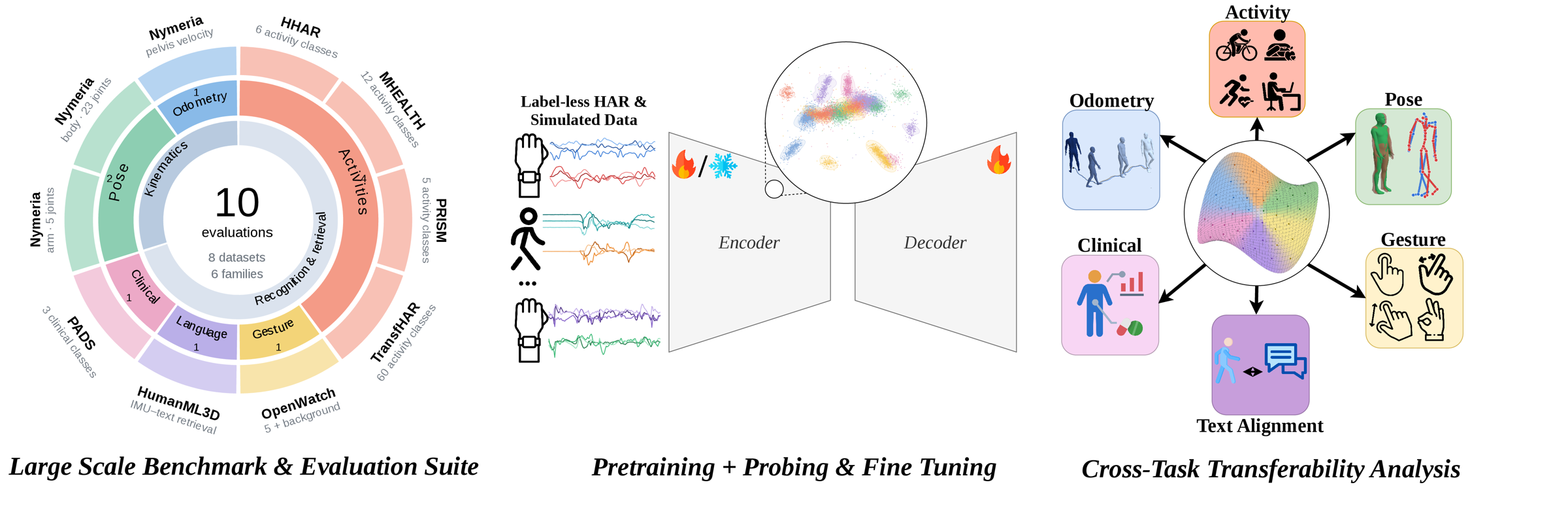
Every number in the paper comes from one registry-driven harness: a task card fixing data, split, input window, decoder, recipe, selection rule and scorer, and an encoder card fixing checkpoint, architecture, input normalization and pretraining corpus.
Ten tasks from eight datasets in six families: pose, odometry, microgesture, IMU–text retrieval, Parkinson's disease and activity recognition.
Six self-supervised objectives on one 12-layer, width-384 ViT (21 M parameters) and one corpus of 197,094 unlabeled windows.
Frozen probing, fine-tuning and training from scratch, each with the same decoder, optimizer, budget, split and selection rule per task.
Every pretraining corpus checked against every evaluation set; duplicated and mirrored participants merged; sensor units verified; evaluation sets excluded from pretraining.
| Task | Dataset | Hours | Output | Metric | Split |
|---|---|---|---|---|---|
| Arm pose | Nymeria | 300 | 5 right-arm joint rotations per 0.32 s patch | position error, cm ↓ | recording session |
| Full-body pose | Nymeria | 300 | 23 SMPL joint rotations per 0.32 s patch | root-relative MPJPE, mm ↓ | recording session |
| Inertial odometry | Nymeria | 300 | pelvis velocity in the wrist frame, integrated to a trajectory | ATE, m ↓ | recording session |
| Microgesture | OpenWatch | 1.9 | 5 gestures + background, voted per clip | clip macro-F1 ↑ | 43 canonical subjects |
| IMU–text retrieval | HumanML3D (simulated wrist) | 28.6 | alignment with CLIP ViT-B/32 text embeddings | mean Recall@1, galleries of 100 ↑ | official test split |
| Parkinson's disease | PADS | 35.9 | healthy / Parkinson's / differential diagnosis per participant | participant macro-F1 ↑ | 469 subjects, disjoint |
| Activity (6 classes) | HHAR | 4.8 | 2.56 s window label | macro-F1 ↑ | subject-disjoint |
| Activity (12 classes) | MHEALTH | 1.9 | 2.56 s window label | macro-F1 ↑ | subject-disjoint |
| Activity (5 classes) | PRISM | 16.3 | 2.56 s window label | macro-F1 ↑ | subject-disjoint |
| Activity (60 classes) | TransfHAR | 2.0 | 2.56 s window label | macro-F1 ↑ | 80/20 in time |
Hours are the sizes of the released datasets. Pretraining sources (released hours): UT-Watch 45.3, WISDM 44.7, RecoFit 43.0, PAMAP2 7.1, SAMoSA 6.7 and Shoaib 6.5 for activity recordings; OCDetect 2,600 and EatingSpeed 525.9 for free-living and meal sessions; Motion-X++ 40.4 and BONES-SEED 144.2 for wrist motion simulated from motion capture. The pretraining set uses 197,094 windows of 10.24 s at 50% overlap, about 280 hours. Summed over their released sizes, the ten pretraining sources hold 3,464 hours and the eight evaluation datasets 391 hours (Nymeria counted once), 3,855 hours in all.
Among the six matched methods, one pretrained encoder is broadly useful. Which supervision is compatible with which target is a separate question, and the benchmark answers it pair by pair.
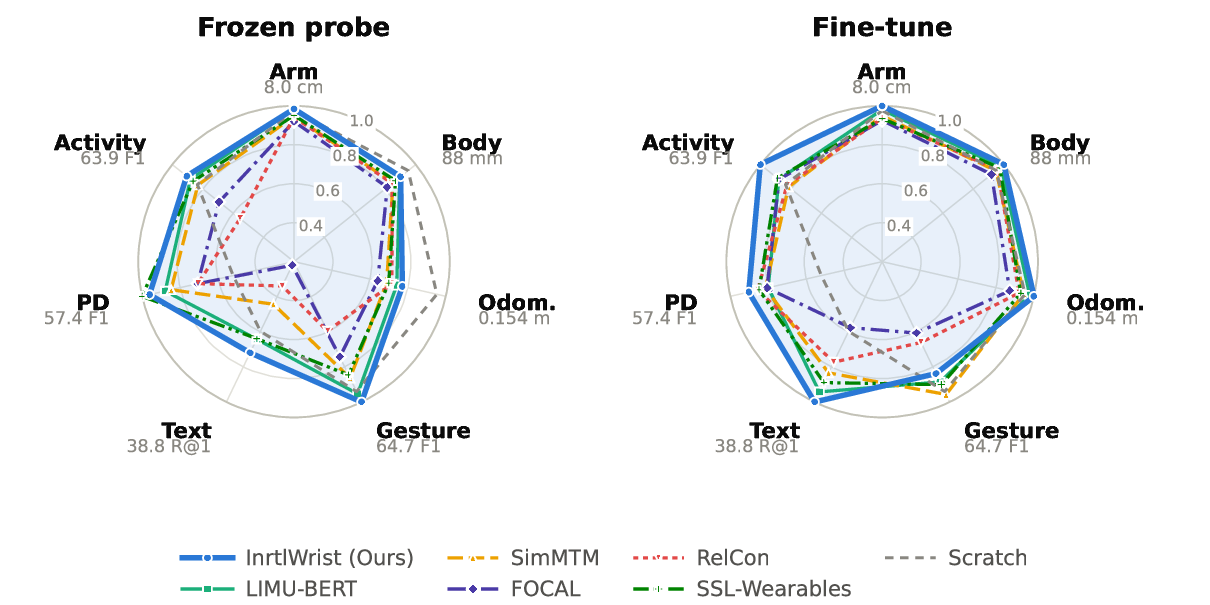
InrtlWrist is best or joint-best under frozen probing on nine of ten tasks and eight after fine-tuning; fine-tuning improves on training from scratch on nine of ten tasks.
Frozen features trail training from scratch on full-body pose and odometry and surpass it after fine-tuning; they already beat it on activity recognition and retrieval.
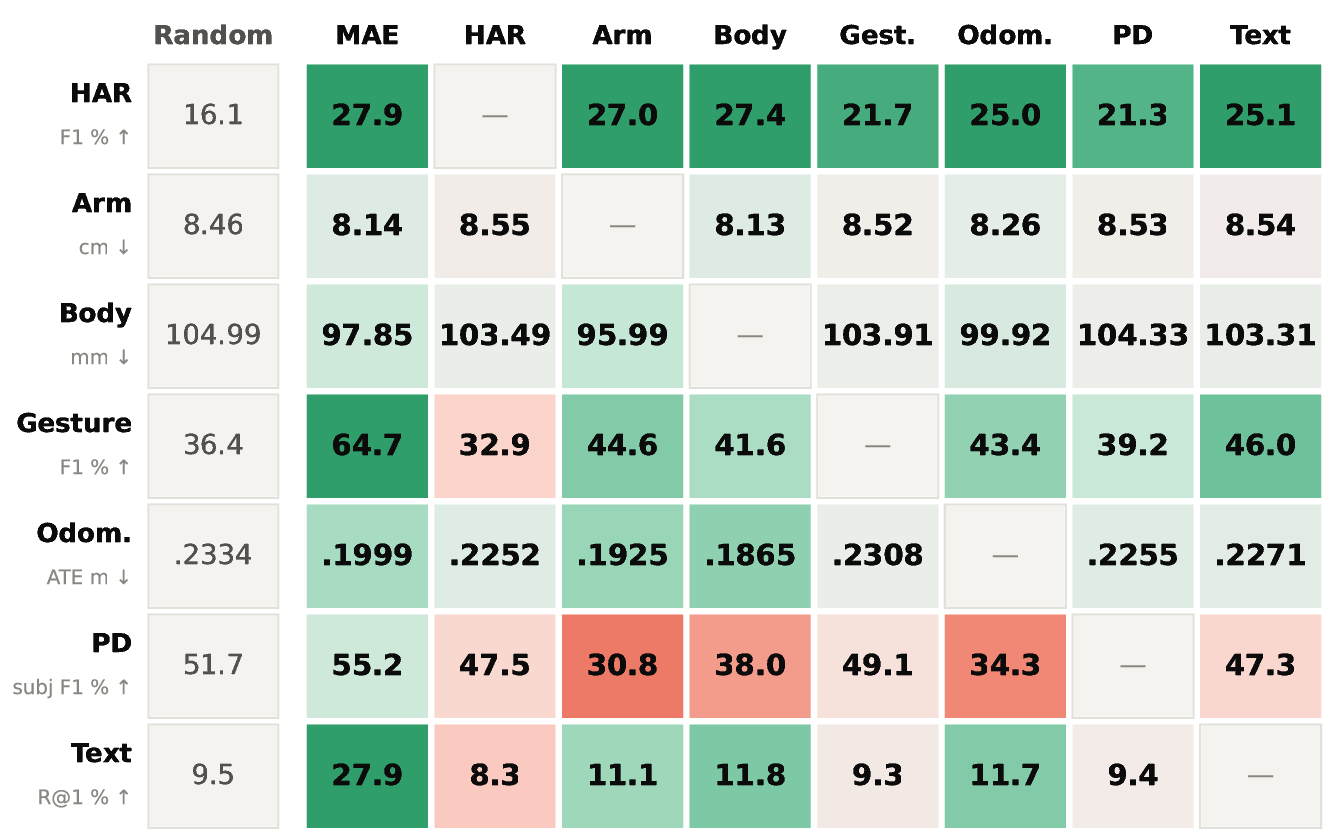
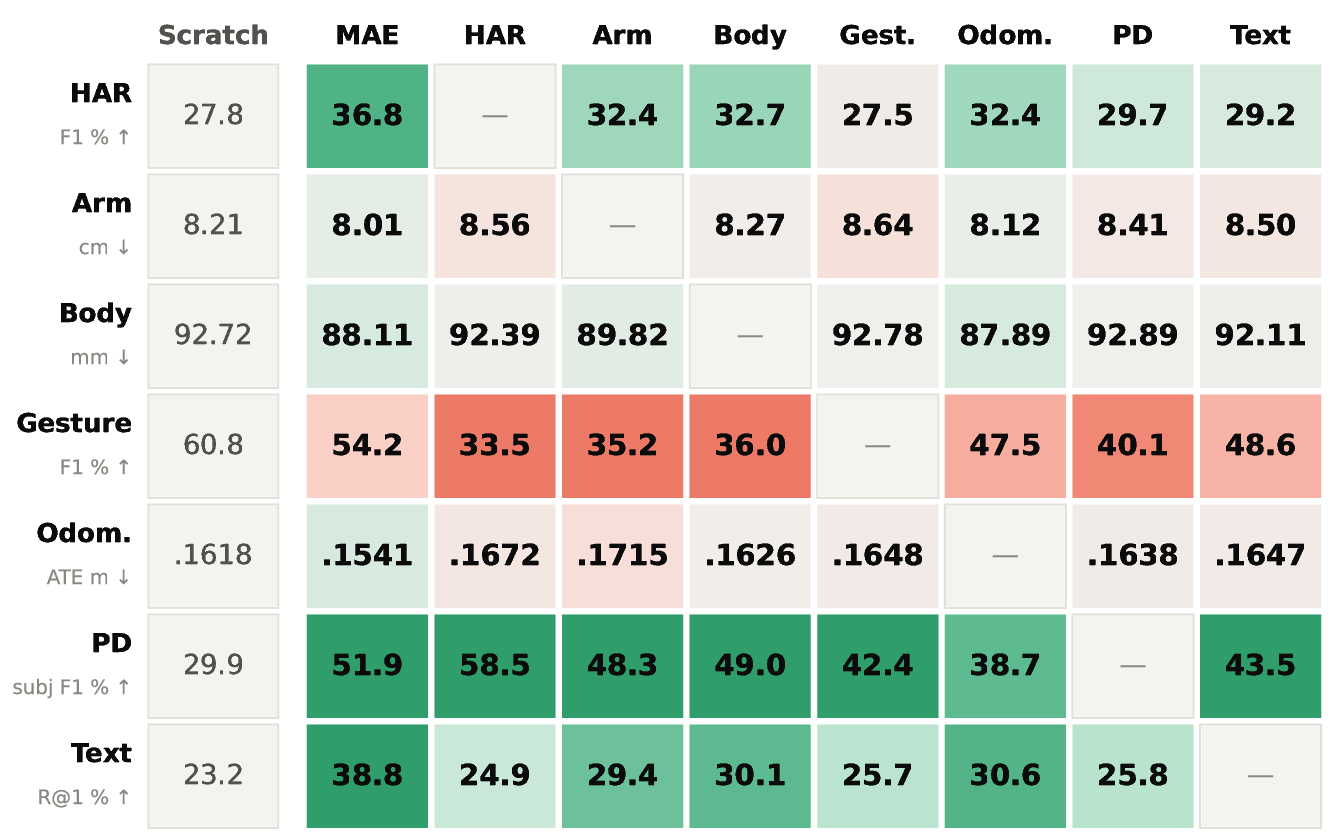
Each kinematic task's best frozen source is another kinematic task. Five of six such transfers survive, at about half their size, when evaluated on disjoint participants.
Under frozen probing, no supervised source approaches InrtlWrist on IMU–text retrieval: at most 11.8 Recall@1 against 27.9.
Pairing full-body pose with odometry or gesture improves the partner task but raises body MPJPE and lowers frozen IMU–text recall.
Frozen InrtlWrist leads the six matched methods on all four activity datasets, with 57.8 mean macro-F1 against 56.2 for LIMU-BERT and 53.3 for training from scratch. Fine-tuning raises the mean to 63.9, with the largest gains on TransfHAR (72.7 to 86.1) and PRISM (27.9 to 36.8), while HHAR favors frozen probing. A random frozen encoder reaches 26.2 under the same readout.
On OpenWatch gestures, frozen InrtlWrist reaches 64.7 clip F1, ahead of every fine-tuned matched method; fine-tuning it drops the score to 54.2 while SimMTM leads at 61.9. On PADS, frozen InrtlWrist reaches 55.2 participant F1, below SSL-Wearables at 57.4 and only 3.5 points above the random frozen encoder, a weaker signal of pretraining benefit than on activity and gesture.
Frozen InrtlWrist beats the random encoder on all three kinematic targets but trails training from scratch on full-body pose and odometry. Fine-tuning reduces full-body MPJPE from 97.9 to 88.1 mm and odometry ATE from 0.200 to 0.154 m, past the scratch baseline at 92.7 mm and 0.162 m, and gives the lowest error among the six matched methods on all five fine-tuned metrics. Arm pose changes little: frozen InrtlWrist and LIMU-BERT tie at 8.14 cm, and fine-tuning reaches 8.01 cm.
Retrained MobilePoser and Air-IO reach 91.9 mm and 0.180 m with their own inputs and recipes; MobilePoser also receives wrist orientation. These results use session-held-out Nymeria recordings with recurring participants, and odometry uses the ground-truth initial orientation over short windows.
| Encoder | Arm, cm ↓probe / fine-tune | Body MPJPE, mm ↓probe / fine-tune | Odometry ATE, m ↓probe / fine-tune |
|---|---|---|---|
| InrtlWrist (ours) | 8.14 / 8.01 | 97.9 / 88.1 | 0.200 / 0.154 |
| LIMU-BERT | 8.14 / 8.18 | 98.5 / 89.7 | 0.208 / 0.158 |
| SimMTM | 8.47 / 8.44 | 103.6 / 92.9 | 0.224 / 0.163 |
| FOCAL | 8.71 / 8.66 | 108.4 / 95.9 | 0.240 / 0.177 |
| RelCon | 8.50 / 8.55 | 104.3 / 92.1 | 0.215 / 0.167 |
| SSL-Wearables | 8.42 / 8.57 | 101.7 / 90.6 | 0.220 / 0.166 |
| Random encoder, frozen | 8.46 | 105.0 | 0.233 |
| Same backbone, scratch | 8.21 | 92.7 | 0.162 |
| Task-specific system | 9.74 (IMUPoser) | 91.9 (MobilePoser) | 0.180 (Air-IO) |
InrtlWrist has the highest mean Recall@1 among the six matched methods under both protocols: 27.9 frozen against 24.9 for LIMU-BERT, 23.2 for training from scratch and 9.5 for the random frozen encoder, and 38.8 after fine-tuning. The advantage persists in the full 3,701-clip gallery, where fine-tuned InrtlWrist reaches 5.1 IMU-to-text and 4.4 text-to-IMU Recall@1 against 2.1 in both directions for scratch.
All encoders receive paired motion–text supervision during downstream training, so these numbers measure how well a pretrained representation supports learning alignment, not zero-shot language alignment.
Each source encoder is trained from scratch on one of seven tasks and evaluated on the other six with a new decoder under the target's split and budget. Under frozen probing, supervised sources beat a random frozen encoder on 28 of 42 pairs, with 15 gains above 10%. Kinematic targets benefit most from kinematic sources: full-body supervision reduces odometry ATE from 0.233 to 0.186 m. All six sources raise PRISM macro-F1 from 16.1 to 21.3–27.4 but fall below the random encoder on PADS, and none approaches InrtlWrist on gesture or IMU–text. Overall, 35 of 42 frozen transfers stay below target training from scratch.
With fine-tuning, 22 pairs improve over scratch and 20 decline. Every source improves IMU–text and PADS, with PRISM supervision reaching 58.5 PADS F1 against 51.9 for direct InrtlWrist fine-tuning. Four of six sources improve full-body pose, and odometry initialization reaches 87.9 mm MPJPE. No source improves odometry, only odometry supervision improves arm pose, and every source reduces gesture F1.
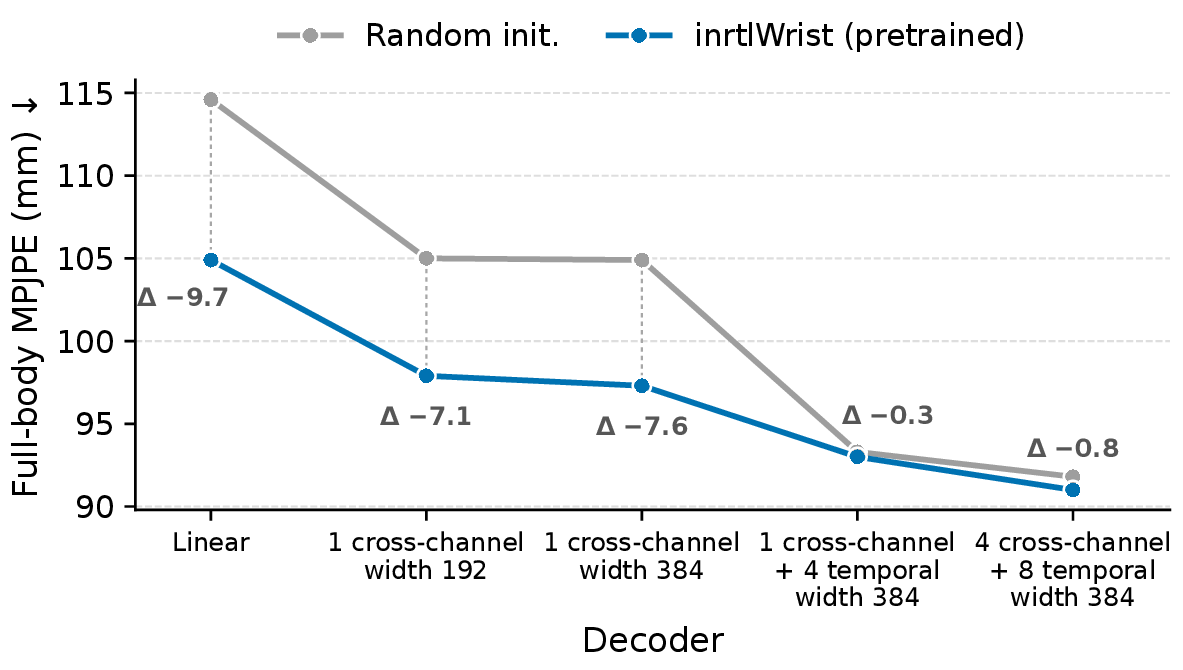
Decoder capacity. With a linear readout, pretraining is worth 9.7 mm of full-body MPJPE over a random frozen encoder, and 7.1 mm with the benchmark decoder. Increasing decoder width changes the gap little, while adding temporal layers reduces it below 1 mm; a 12-layer odometry decoder lets the random encoder outperform every pretrained one. The benchmark therefore uses light readouts.
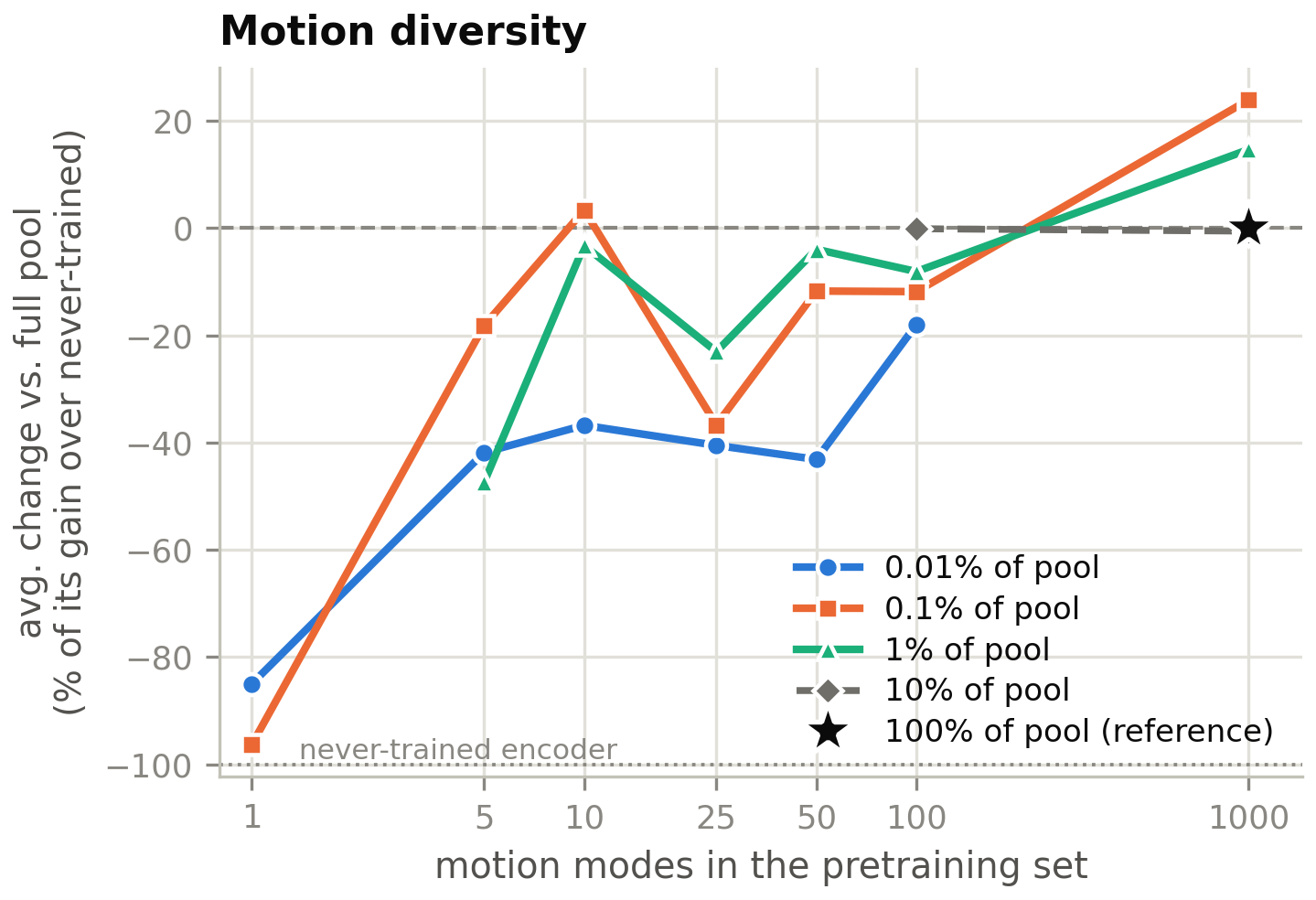
Pretraining data and motion coverage. Holding architecture, probes and budget fixed, uniform draws from 0.1% to 100% of a 1,959,288-window pool perform alike at 50,000 updates, and the 0.01% subsets trail the 0.1% subsets at every coverage level. Restricting pretraining to subsets of 1,000 motion clusters hurts most when few clusters are available. These findings are conditional on the budget and sampling scheme.
Joint task supervision. Fine-tuning InrtlWrist jointly on full-body pose and a partner task improves odometry ATE from 0.154 to 0.149 m and gesture F1 from 54.2 to 65.0, but increases body MPJPE and lowers frozen IMU–text Recall@1.
The arXiv and PDF links will be added when the preprint is public.
Every number on this page is produced by the released harness from task cards and encoder cards; the per-cell result files, secondary metrics and the corpus audit are part of the release.
@article{imubench2026,
title = {IMU-Bench: Benchmarking Wrist IMU Representations
Across Kinematic, Semantic and Clinical Tasks},
author = {Li, Yiquan and Bradshaw, Aidan and Gao, Chenfeng and Ahuja, Karan},
journal = {arXiv preprint arXiv:2610.19481},
year = {2026}
}